DeepSeek-V2
The 2024 paper that disrupted the AI pricing landscape by introducing Multi-Head Latent Attention (MLA), drastically reducing the memory required for the KV Cache.
Paper: DeepSeek-V2: A Strong, Economical, and Efficient Mixture-of-Experts Language Model
Authors: DeepSeek-AI · 2024
Read the paper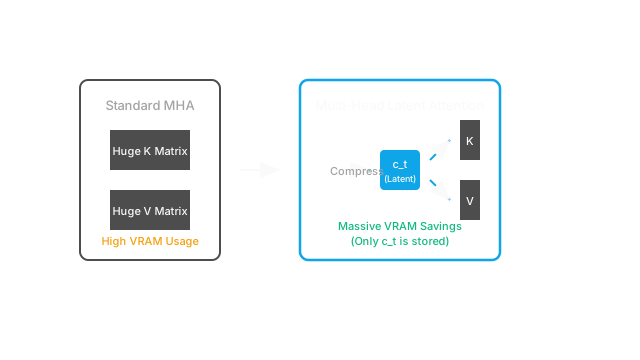
The Problem
As LLMs became standard in production, companies realized the main bottleneck to serving them wasn't compute (FLOPs), but memory (VRAM). Specifically, to generate text quickly, models store the representations of all previous tokens in a "KV Cache" (Key-Value Cache). For long context windows and thousands of concurrent users, the KV cache grows to hundreds of gigabytes, severely limiting how many users a single GPU can handle. Techniques like Grouped-Query Attention (GQA) helped, but didn't solve the core memory bottleneck.
The Idea
DeepSeek-V2 introduced Multi-Head Latent Attention (MLA). Instead of storing the full Key and Value vectors for every token in every attention head, MLA compresses them into a single, low-dimensional "latent" vector. When the model needs to calculate attention, it uncompresses (projects) this latent vector back into Keys and Values on the fly. This trades a tiny amount of extra compute for a massive reduction in VRAM usage.
How It Works
In standard Multi-Head Attention (MHA) or GQA, the and matrices are stored in memory for the duration of the generation.
In MLA:
- The model projects the hidden state of a token into a small latent vector .
- Only is stored in the KV Cache. Because is very small, the memory footprint drops by 90%+.
- During generation, is multiplied by "up-projection" matrices to reconstruct the and vectors needed for the attention calculation.
- To handle positional information (RoPE), which doesn't compress well, a separate, small RoPE token is kept alongside the latent vector.
Combined with a highly optimized Sparse Mixture-of-Experts (MoE) architecture, DeepSeek-V2 achieved incredible efficiency.
Why It Mattered
DeepSeek-V2 matched the performance of top-tier models (like Llama 3 70B) but cost significantly less to serve. DeepSeek passed these savings on to developers, launching an API that was nearly 10x to 100x cheaper than OpenAI's GPT-4, triggering an industry-wide price war for API access.
What Came After
The success of DeepSeek-V2 and its successor V3 proved that extreme architectural efficiency (MLA + MoE) could allow smaller, well-funded labs to compete directly with trillion-dollar tech giants. It also established Chinese AI labs as absolute frontier players in open-weights model development.