Frequentist vs Bayesian
The philosophical divide at the heart of statistics: is probability a physical property of the world, or a measure of human ignorance?
Verdict: Frequentist methods are fast, standard, and objective, but often answer the wrong question. Bayesian methods answer the exact question you care about, but are computationally expensive and require subjective assumptions.
The Short Answer
This is not a debate about formulas; it is a debate about the fundamental definition of the word "probability."
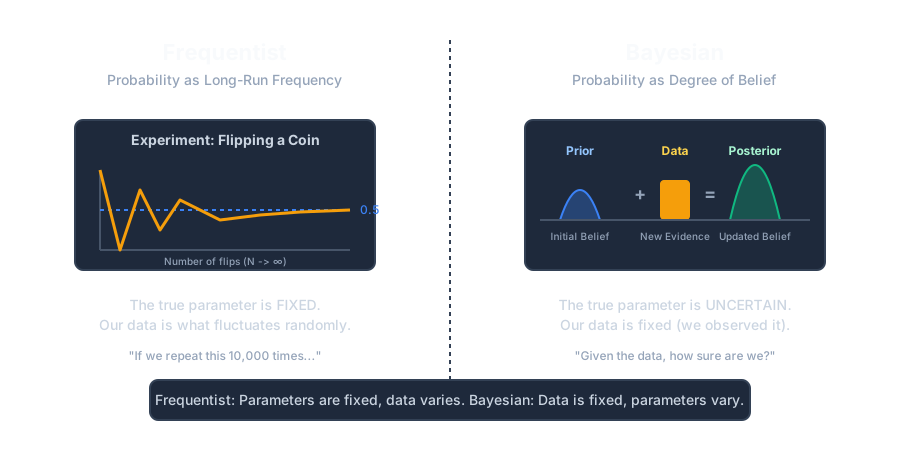
- The Frequentist believes probability is the long-run frequency of an event. A coin has a 50% probability of landing heads because if you flipped it an infinite number of times, exactly half would be heads. The parameter (the fairness of the coin) is a fixed physical property.
- The Bayesian believes probability is a degree of human belief. Before flipping the coin, I believe there is a 50% chance it lands heads. If I flip it 10 times and get 10 heads, I update my belief. The data is fixed (I saw the 10 heads), but the parameter (the fairness of the coin) is uncertain and modeled as a probability distribution.
Where They Differ
| Feature | Frequentist | Bayesian |
|---|---|---|
| Definition of Probability | Long-run frequency of repeatable events. | Degree of belief or certainty. |
| The Parameter | Fixed and unknown. | Random variable with a distribution. |
| The Data | Random (one realization of infinite possibilities). | Fixed (we observed it, it cannot change). |
| Key Output | Point estimates, Confidence Intervals, p-values. | Posterior distributions, Credible Intervals. |
| Prior Knowledge | Ignored completely. | Required mathematically (The Prior). |
The "Confidence Interval" Translation Error
The biggest practical difference shows up in how we interpret uncertainty.
If a Frequentist calculates a 95% Confidence Interval for the conversion rate of a website as [0.12, 0.18], what does that mean?
Most people think it means "There is a 95% chance the true conversion rate is between 12% and 18%." This is strictly false in Frequentist statistics.
The true rate is a fixed number. It's either inside the interval (100% chance) or outside it (0% chance). A Frequentist must say: "If I ran this exact A/B test 1,000 times and generated 1,000 different intervals, 950 of them would contain the true rate."
If a Bayesian calculates a 95% Credible Interval as [0.12, 0.18], they can proudly say exactly what business stakeholders want to hear: "Given the data we saw, there is a 95% probability that the true conversion rate lies between 12% and 18%."
Choose Frequentist When
- You want standard, universally accepted metrics: The scientific publishing world still largely runs on Frequentist p-values (for better or worse).
- Computation speed matters: Calculating a standard t-test or linear regression takes milliseconds.
- You have massive amounts of data: As datasets get larger, Bayesian and Frequentist estimates converge to the exact same numbers. If you have 10 million rows, the prior doesn't matter anymore.
Choose Bayesian When
- You have very little data: If you only have 5 observations, a Frequentist model will give you wildly unstable answers. A Bayesian model allows you to inject common sense (a Prior) to stabilize the model until you get more data.
- You need true probabilistic answers: If a self-driving car needs to know "What is the probability that object is a pedestrian?", it needs a Bayesian distribution, not a Frequentist long-run frequency (it can't run the scenario 10,000 times to find out).
- You want to incorporate expert domain knowledge: You can encode a doctor's expertise into the Prior before the model even looks at the data.
What People Get Wrong
Thinking Machine Learning is purely Frequentist
While traditional statistics relies heavily on Frequentist A/B tests, modern Machine Learning is deeply Bayesian. L2 Regularization (Ridge) is mathematically identical to applying a Gaussian Prior to your weights. The loss function in classification (Cross-Entropy) is derived from Maximum A Posteriori (MAP) estimation, a core Bayesian concept.